Blog Training & science
Train smarter, get stronger: the science-backed blueprint for general fitness and strength
Most people spend years spinning their wheels in the gym, not because they lack effort, but because they have never learned what actually moves the needle when it comes to building real, lasting strength and fitness.
The difference between a lifter who plateaus after six months and one who keeps getting stronger for years isn't genetics or talent. It's understanding the principles that drive adaptation and applying them with intelligence and consistency. This article lays out exactly those principles, drawn from the science of strength training, so you can stop guessing and start progressing.
Start with the basics: why fundamental lifts carry the programme
If there is one rule that cuts through the noise of modern fitness culture, it's this: compound movements built the strongest humans who ever lived, and they'll build you too. Strength is developed by exercises that use lots of joints and lots of muscles, moving lots of weight over a long range of motion. The squat, deadlift, bench press, overhead press, and power movements like the clean and snatch are the most efficient core for most programmes. Isolation exercises still have a place: working around an injury, bringing up a weak point, or adding muscle where the big lifts don't reach.
What makes these lifts so effective is their efficiency. Using multijoint, large muscle mass exercises such as cleans, arm pulls, and squats provides greater transfer to athletic performance compared with single-joint, small muscle mass exercises. When you squat, you're not just training your legs; you're training your entire posterior chain, your core, your nervous system, and your capacity to produce coordinated force under load.
The case for limiting your exercise selection, especially early in your training career, is equally compelling. By focusing your efforts on mastering a select few lifts rather than cycling through dozens of exercises, you can clearly track the effectiveness of your program and learn proper form far more quickly. Equally important, training the same lifts with higher frequency reinforces neuromuscular patterns, enhancing both intra- and inter-muscular coordination, and since early strength gains depend primarily on neuromuscular efficiency, frequent repetition of the same fundamental movements is the fastest path to meaningful progress.
Train for strength: the goal you can actually measure
Of all the goals you can pursue in the gym (fat loss, general fitness, endurance, aesthetics), strength is uniquely valuable because it is objectively measurable. If you can lift more weight today than you did last month with the same form and the same range of motion, you are a stronger version of yourself, and you can accurately conclude that your training is paying off. No other fitness metric offers that level of certainty. The scale lies. The mirror distorts. Strength numbers don't.
This measurability has a powerful psychological effect. Watching a client hit a new personal record (PR) validates months of hard work in a single, undeniable moment. People who train for strength goals are more likely to stay consistent because hitting new PRs is motivating, even addictive. They keep showing up month after month, and as their consistency grows, so do their physique results, creating a virtuous cycle of effort and reward.
There is also a meaningful physiological link between getting stronger and gaining muscle. While the relationship is imperfect, there is a direct correlation between strength gains and hypertrophy: as muscles grow, strength increases, and vice versa. This means that even if your primary goal is a better physique, training for strength serves your objectives simultaneously. You're not choosing between looking good and being strong; you're pursuing both at once.
The big three training variables: volume, intensity, and frequency
No conversation about effective training is complete without addressing the three variables that actually determine results: volume, intensity, and frequency. These three elements are interrelated and inseparable, and they collectively form the true foundation of any effective training program. Changing one necessarily affects the others, and optimizing the combination of all three, based on your training age, goals, and recovery capacity, is the central challenge of intelligent program design.
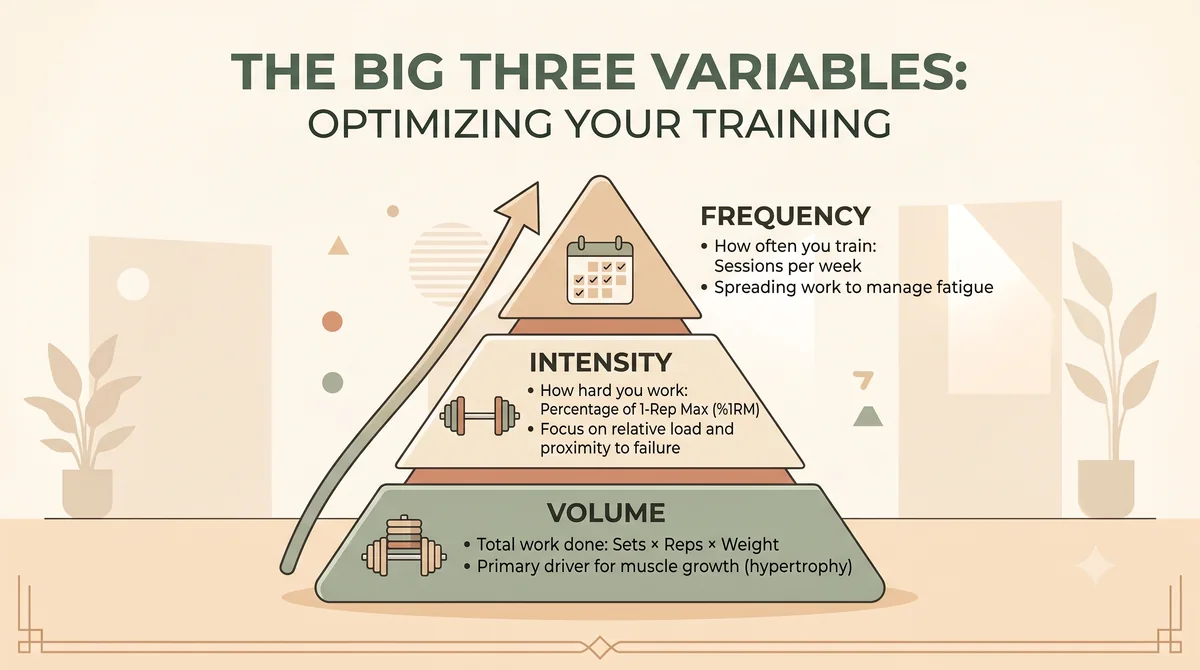
How often should you train? When total weekly volume is the same, frequency on its own matters less than people think. For most beginners and intermediates, two to three full-body sessions a week is a practical starting point. Training more often mainly helps you spread the work out, so each set is done with higher quality instead of packing everything into one exhausting session.
When it comes to loading intensity, the principle is simple: most of your strength work should be heavy, but not maximal. Even elite lifters spend only a small part of their training near their true max. Spending too much time near maximal loads leads to accumulated fatigue and diminishing returns, a critical mistake many enthusiastic lifters make.
Prioritisation and programming: focus your efforts where they count
One of the most common and costly mistakes intermediate lifters make is trying to improve everything at once. Athletes attempting to simultaneously advance their Olympic lifts, squat, deadlift, bench press, rows, presses, and hypertrophy work will eventually find that the cumulative fatigue from one lift compromises every other. Trying to increase clean performance leaves you too fatigued for squats; squats drain you for pressing. Progress stalls across the board. The solution is prioritization.
The fix is to pick one or two priorities per training block and put most of your training volume behind them. Everything else is maintained, not developed. This kind of focused allocation of effort is what separates programs that produce results from programs that merely generate fatigue.
There are three distinct ways to direct your training priorities:
- Movement pattern. Choosing to concentrate on the squat, the bench press, or a specific Olympic lift.
- Motor quality. For example, pursuing relative strength while maintaining current muscle mass, or focusing on maximal hypertrophy while sustaining strength levels.
- Combination of both. Simultaneously targeting a technical element of a movement and the muscular quality underlying it.
Whichever direction you choose, the principle of specificity applies: to get better at a movement, practise that exact movement frequently and with full intent.
Recovery, exercise sequencing, and avoiding staleness
Training hard is only half the equation. Training smart, meaning strategically sequencing your efforts and protecting your recovery, determines whether that hard work converts into adaptation or accumulates as fatigue. A foundational point in strength science is that strength gains are greater when athletes train in a recovered state. This is especially true for neural adaptations, which require the central nervous system to be fresh. Strength development is, at its core, a learning process, and that learning is more successful when the trainee is not fatigued from prior activity.
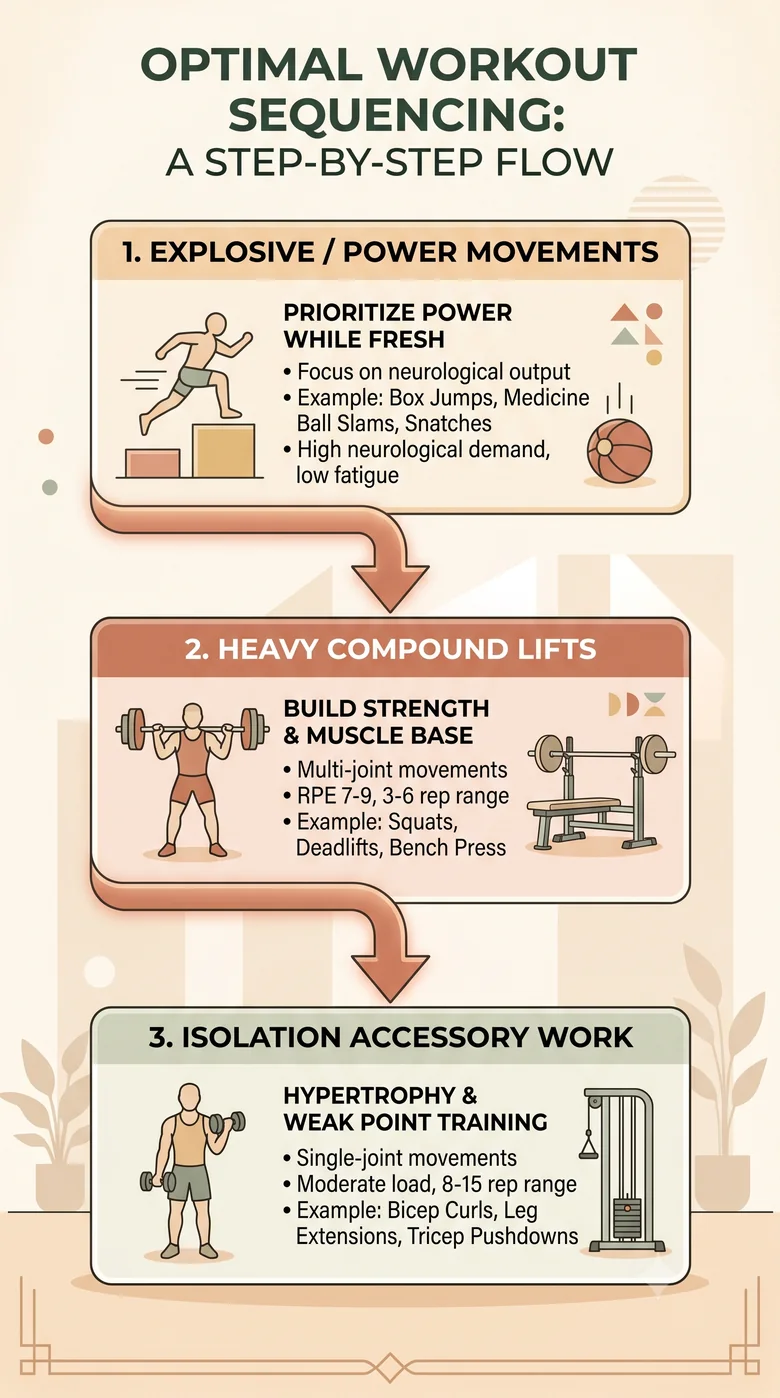
Within individual training sessions, exercise sequencing matters enormously. A clear hierarchy must be followed: perform the most demanding exercises first, right after the warm-up: those requiring fine motor coordination and maximal neuronal output. Specifically, dynamic and power-type drills should precede slower movements like squats, and larger muscle groups should be trained before smaller ones. Placing your most critical movements at the beginning of a session, when your nervous system is freshest, ensures that the adaptations you're chasing actually occur under optimal conditions.
On the question of staleness, a critical distinction must be drawn: the solution to accommodation is not constantly swapping exercises. It is varying the training load. A stable exercise complex should be maintained throughout a mesocycle to allow genuine adaptation to occur, while changes in loading (sets, reps, rest periods, and intensity) provide the variability needed to prevent premature accommodation. Mixing harder and lighter days across the week is a simple but powerful tool for managing fatigue.
Long-term progress: periodization, lifestyle, and knowing when to adapt
For lifters with serious long-term goals, periodization, the systematic cycling of volume and intensity across weeks and months, is not optional; it is essential. The foundational pattern follows a clear progression: early in a training plan, during the preparatory phase, volume is higher, intensity is lower, and sport-specific training is minimized. As the athlete moves closer to a competitive or peak phase, volume decreases, intensity climbs, and training becomes increasingly specific. This phased approach allows the body to absorb and express adaptation in a structured, sustainable way.
So when do you change things? Every three to six weeks, review the block: keep the main lifts, and adjust sets, reps and load based on how you progressed and recovered. Swap an exercise only if it has stopped working or causes pain. This isn't program-hopping; it's deliberate adjustment inside a framework that already has its fundamentals in place.
It is equally essential to clean up the other areas of your life: getting good sleep, eating well, and managing stress are not complementary extras. They are non-negotiable prerequisites. No program, however brilliantly designed, can overcome chronic poor recovery.
Finally, lifters at every level should consider working with a coach or a strong training partner. Even experienced athletes have blind spots in their form, their programming and their effort levels that are nearly impossible to detect from the inside. A good coach or motivated training partner brings an external perspective that accelerates progress in ways that solo training rarely can.
Key takeaways
- Compound movements first: the squat, deadlift, bench press and overhead press are the most efficient tools for building strength for most people; isolation work fills the gaps.
- Strength is the metric you can check: if you're lifting more weight with the same form than last month, your training is working.
- Balance volume, intensity and frequency: optimise all three together; most strength work heavy, but not maximal.
- Prioritise 2 goals per mesocycle: put most of your volume behind them; trying to improve everything at once stalls progress across the board.
- Sequence and manage load: most demanding exercises first, train in a recovered state, and vary load, not exercise selection, to prevent staleness.
- Periodise and recover: cycle training across phases, review each block every 3–6 weeks and adjust the load, not the whole program, protect sleep and nutrition, and consider a coach to spot blind spots.
Sources
- Rippetoe, M. & Kilgore, L., Practical Programming for Strength Training.
- Zatsiorsky, V. M. & Kraemer, W. J., Science and Practice of Strength Training (3rd Ed.).
- Bompa, T. O. & Haff, G. G., Periodization: Theory and Methodology of Training (6th Ed.).
- Contreras, B., Glute Lab: The Art and Science of Strength and Physique Training.
- Helms, E., Morgan, A. & Valdez, A., The Muscle and Strength Training Pyramid.
- Grgic, J., Schoenfeld, B. J. et al. Effect of Resistance Training Frequency on Gains in Muscular Strength: A Systematic Review and Meta-Analysis. Sports Medicine – Open, 2018.
Want a program that actually applies this?
Prioritised goals, the right volume and intensity, smart sequencing, adjusted every week: that's what I build with my clients. No guesswork, no program-hopping.
This article is general information, not medical advice. If you have a health condition, are pregnant, or take medication, talk to your doctor before changing how you train or eat. See the Health Disclaimer.